HAWK
An internal workflow automation platform, built end-to-end for Bentley Motors Limited.
Bentley's Version Change Request (VCR) — the legal sign-off behind every piece of software released onto a vehicle — was slow, manual and owned by no single department.
HAWK: an internal workflow automation platform that replaces the manual VCR process end-to-end, running entirely on Bentley's own infrastructure.
I led it end-to-end — stakeholder discovery, the board-level business case, then self-taught the full stack and built the platform solo.
Fully live since 22 May 2026 and used daily by engineers across Bentley R&D, with overwhelmingly positive early feedback — projected to save £11.5m over six years.
19 months
End-to-end delivery
~200 engineers
In the live rollout across Bentley R&D
57%
Faster per VCR (50.9 → 21.8 hrs)
£11.5m
Projected 6-year saving
“Super essential.”
Dr. Walliser’s reaction after my team first pitched the idea to him in the early stages. He immediately recognised that VCR was a purely administrative process where Bentley’s engineers were adding little value — and was therefore primed to be automated.
At a glance
The fast version
Outcome
Before HAWK vs. after HAWK
The new tool gives engineers the information they need in a faster, clearer format — without reinventing the underlying business process.
Slow & manual
Multiple PDF forms, hand-filled, with the same data repeated across every document.
Automated end-to-end
Direct integration with existing Bentley & VW systems removes manual entry and de-duplicates data at source.
Lots of repeat work
A single typo meant restarting every document from scratch — hours of avoidable rework per VCR.
Validation & governance
Built-in checks raise right-first-time submissions and protect data quality before it leaves the engineer.
No visibility
PDFs were emailed for signatures with no way to track who still needed to approve.
End-to-end digital workflow
Integrated approval and signing — full visibility of status, owners and bottlenecks across departments.
My role
Lead engineer & project owner — end to end
My manager gave me autonomy over the direction, the technical build, and the stakeholder relationships. The UX/UI and IT teams supported at the right moments; I owned delivery.
Discovery & strategy
- Stakeholder interviews
- Requirements & PDS
- Cost-benefit & risk docs
- Board-level presenting
Engineering
- Next.js / React frontend
- Spring Boot API & SOAP bridge
- MSSQL schema design
- VM deployment & CI
Delivery & leadership
- UX/UI onboarding pack
- Weekly cross-team scrums
- Specialist input to IT
- Live trial → launch with ~200 engineers
The problem
A high-friction process, shared between many departments
The VCR (Version Change Request) is the legal mechanism that signs off every piece of software released onto a Bentley vehicle. Because ownership was spread across multiple departments, no single team was positioned to fix it — and the cost compounded with every change shipped.
What stakeholders told me
- The process was manual and time-consuming.
- Different teams needed the same information in different places.
- Small changes could take far too long to progress.
- Avoidable rework: a single typo meant restarting every document.
- No-one could see who still needed to sign.
- No team owned the end-to-end process, so no team could fix it.
What I turned that into
A clear, measurable business problem: reduce engineer effort per VCR without losing control or quality — and do it in a way Bentley can own and evolve for years to come.
I authored a structured requirements list from the stakeholder interviews, produced a feasibility analysis, and built the risk & cost-benefit case used to secure board backing.
The journey
From a vague problem to a live platform
Nineteen months of progressive delivery. Each step de-risked the next.
- Step 1Autumn 2024
Learned the business
Onboarding, internal e-learning (sustainability, cyber-security), and process shadowing across R&D. Scoped an unowned problem: the VCR process was shared between several departments — owned by all, optimised by none — and had resisted a fix for over a year.
- Step 2Winter 2024
Stakeholder discovery
Embedded with every stakeholder department — running the interviews myself to capture pain points first-hand and translate them into a structured requirements list and customer-needs document.
- Step 3Jan 2025
Evaluated the options
Compared off-the-shelf vs bespoke against time, cost, maintainability and compatibility with Bentley & VW Group infrastructure. Concluded an in-house build was both cheapest and lowest risk.
- Step 42 Apr 2025
Board approval
Presented the business case, risk register and cost-benefit analysis to the board and secured backing to proceed in-house.
- Step 52025 – early 2026
Built the platform
Self-taught TypeScript, Next.js and Spring Boot. Prototyped the data layer on PostgreSQL, then moved production onto MSSQL to sit alongside Bentley's existing databases. Designed the split architecture to bridge a clean modern UI to the Volkswagen Group's Java 8 SOAP services.
- Step 6Spring 2026
Third-party security audit
Independent code review: 0 critical, 10 high, 9 medium, 5 low. All 24 issues remediated before launch.
- Step 722 May 2026
Live launch
HAWK went live on Bentley's internal infrastructure, following a live trial with around 200 R&D engineers that began in February 2026.
Architecture
A split stack: modern UX, legacy compatibility
The hard constraint was Volkswagen Group's Java 8 SOAP services — incompatible with modern frontends. I split the stack so the user-facing layer could be modern while the integration layer stayed compatible with the legacy world.
Engineer
Browser, internal network only
Next.js UI
Modern, responsive UX designed with Bentley's UX/UI team
Spring Boot API
The bridge. Translates a modern REST UI into legacy SOAP calls — isolating the Java 8 constraint to one layer.
MSSQL database
VCR data, audit trail, signatures. Schema aligned with Bentley's existing data stack.
VW Group services
Live integration with System 42 (Java 8 SOAP) — the canonical Volkswagen Group data.
Why this mattered
- The frontend was free to deliver the UX the business actually wanted.
- The backend kept legacy compatibility intact — no risky rewrite of VW services.
- Splitting the stack isolated the Java 8 constraint to a single, well-tested layer.
Key design decisions
- Prototyped on PostgreSQL; production runs on MSSQL — a pragmatic choice to align with Bentley’s existing databases.
- Kept maintainable and scalable so the platform can grow beyond VCR.
- On-prem VM deployment for secure, realistic operation behind the firewall.
Tech stack
Self-taught, end to end
I taught myself most of this stack during the project, with Claude and Claude Code used deliberately as core engineering practice — AI-accelerated development is how one engineer delivered at team speed against an enterprise codebase. HAWK itself ships no AI features: the product stack runs in production; the rest is how I built it.
The product
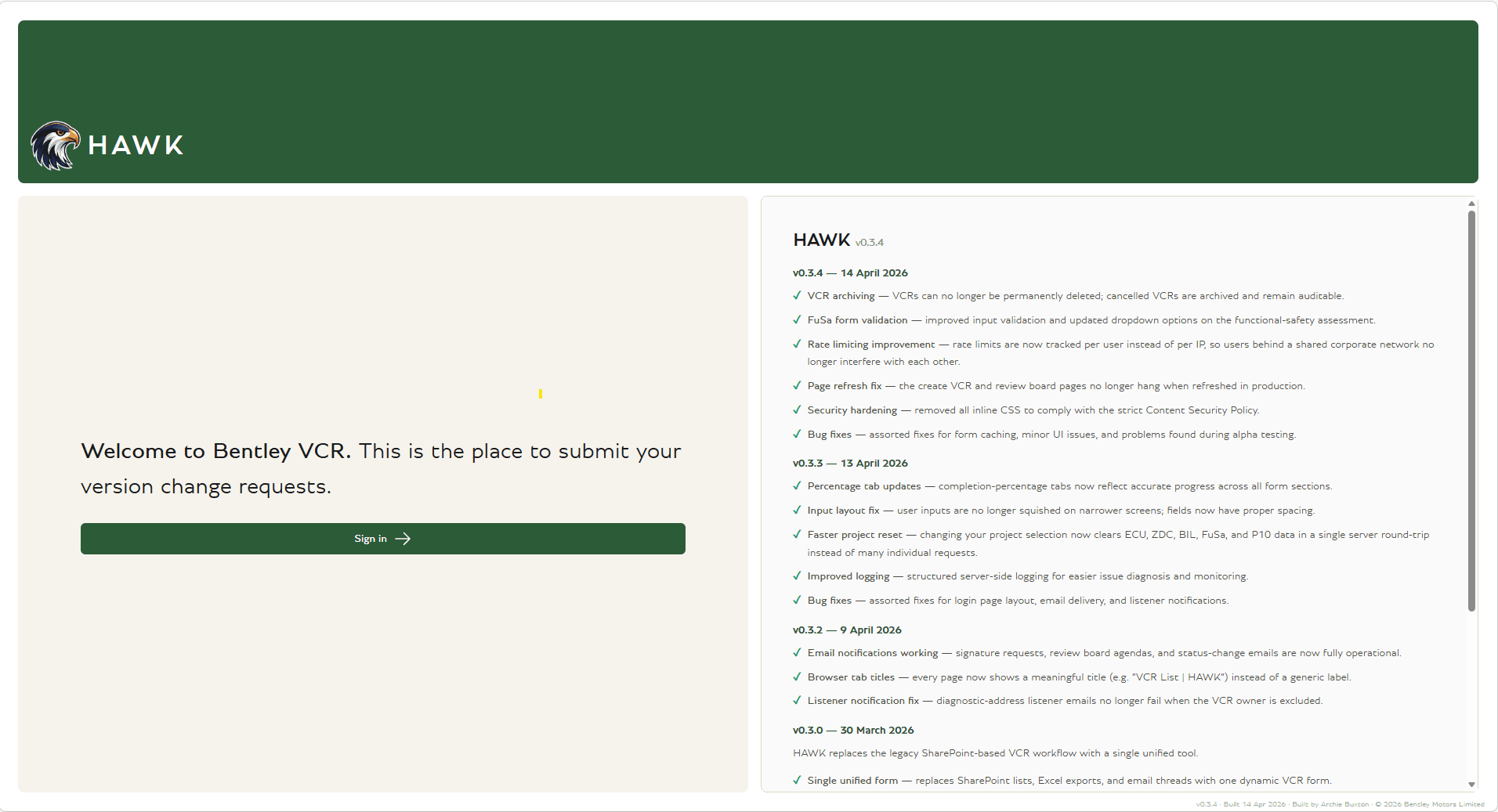
HAWK, in use
A walkthrough of the live tool, used daily by engineers across Bentley R&D. HAWK runs only on Bentley's internal network — these screenshots are the only public view.
Business impact
Projected value, straight from the business case
The business case I presented to the board projected the savings across the first six years of operation — every figure below is a projection from that case, not a realised number.
£860k
Projected saving in 2026 — the first year of operation
£11.5m
Projected saving across the first six years
50.9 → 21.8 hrs
Effort per VCR — a 57% reduction
Projected annual saving
£ millions per year · indicative ramp · efficiency saving only
Source: business case presented to the Bentley board, April 2025. The £860k first-year and £11.5m six-year totals come from that case; the year-by-year split is an indicative ramp, and every figure is a projection.
Leadership & collaboration
Built independently — delivered collaboratively
The technical work was largely solo, but HAWK only ships because of the people around it. I designed the way those teams plugged in.
Stakeholders & UX/UI
- Two rounds of stakeholder interviews — discovery, then design validation.
- Produced a detailed onboarding pack so the UX/UI team could contribute from day one.
- Weekly scrums kept dev and design aligned on scope, timeline and quality bar.
- Balanced creative input with delivery cost — keeping the business on track.
IT, governance & the board
- Authored risk and cost-benefit documentation for Bentley IT governance.
- Became the specialist reference for IT on the legacy SUMS process.
- Presented the business case directly to the board to secure approval.
- Became R&D’s main point of contact for the future direction of the tool.
Quality & security
Independent third-party security audit
Before launch, HAWK went through a full independent third-party security review of the codebase — essential, given that HAWK now sits on the path of every software release onto a Bentley vehicle.
Audit headline
100% of the code was written by me, and this was the first formal security audit of code I had written. Zero critical findings — every high-severity issue fixed before launch, one month later.
For a solo-built, first-audit codebase, zero critical findings was a strong validation of the architecture and engineering practices I had applied throughout — and all ten high-severity items were triaged and remediated in the month between audit and the 22 May 2026 launch.
Reflection
What HAWK taught me — and what's next
HAWK started as a high-friction process shared between multiple departments, where no single team was empowered to fix it end-to-end. The biggest unlock wasn’t the code — it was treating the legacy Java 8 constraint as a layered architecture problem rather than a blocker, and getting the right people into the right conversations at the right time. In hindsight the shape is recognisable: the forward-deployed motion — embed, scope, build, deploy — executed end-to-end inside one enterprise. The most rewarding moment was watching engineers begin using it live: the point where a business case starts turning into a result.
HAWK isn’t finished. With the platform live, the roadmap shifts toward dashboards, automation hooks, and integrating adjacent R&D workflows — turning a single tool into the basis for a wider operational platform.
A question I put to the board
“Matthias — how many other processes inside R&D could deliver millions in saving if we resourced more people like me?”
Directed to Matthias Rabe, Board Member for R&D. That was the question I left with the board: how many other internal processes are primed for the same kind of projected return? It’s the question that now shapes where HAWK’s roadmap goes next inside Bentley.